
Finding Immigrant Ancestors

I remember asking my Dad one time if he had any interest in researching his ancestors in Europe, particularly our Jones line from northern Wales. He said no, not really. He was only interested in discovering the original immigrants in each line of his deeply American family tree.
I thought that was interesting. I guess I’m a little different. I like making discoveries about my heritage in the old country. However, I definitely share my Dad’s passion for taking each ancestral line back to its point of immigration. Below is the fan chart Dad created in 1995 when he self-published his genealogical findings.[1]Nelson Jonnes, “Jonnes Family Record 1995,” 3rd edition, unpublished manuscript; bound copy #6 privately held by Steven Nelson Jonnes, Ashburn, Virginia, 2026. Many lines have been extended since then, of course.
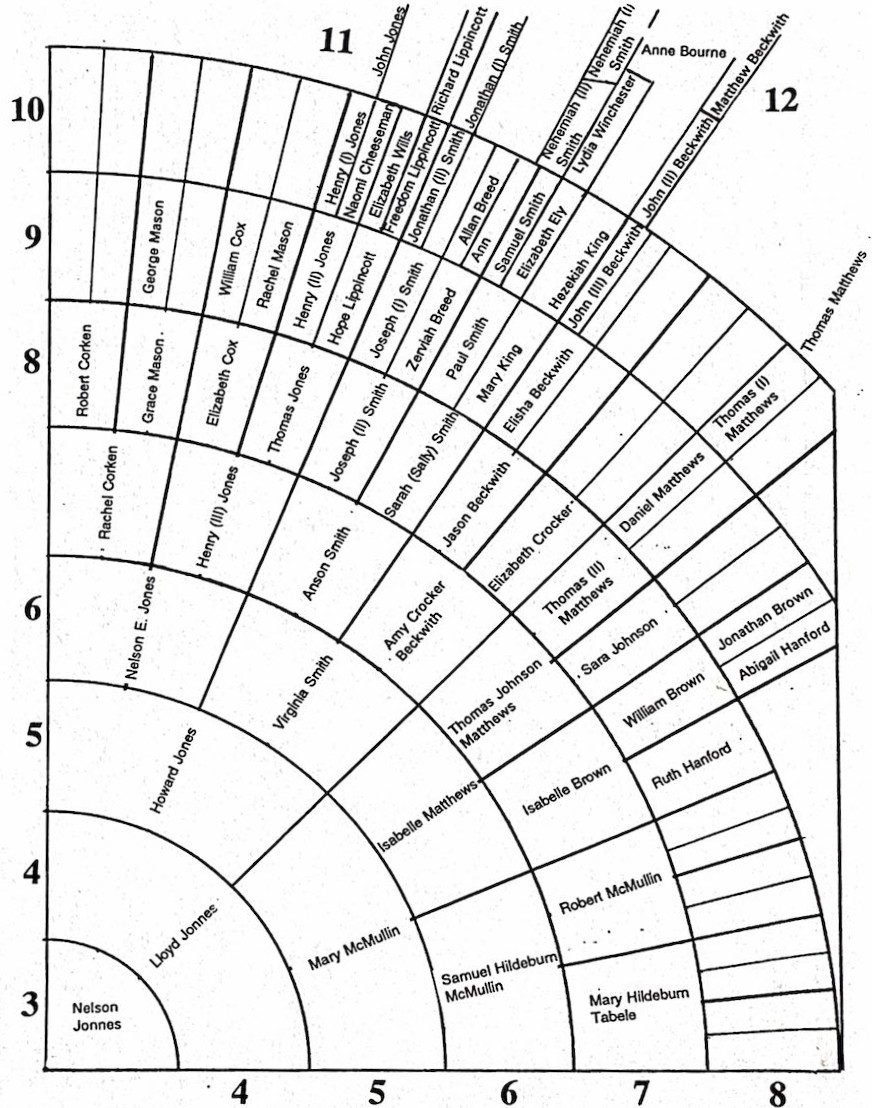
Nelson Jonnes paternal side fan chart (Created by Nelson Jonnes, 1995)
Discovering immigrant ancestors is a primary genealogical goal for me, too. Who are my immigrant ancestors? Where did they come from and why?
When I identify immigrant ancestors, I place the logo at the top of this post in their profiles.
The difference between Dad and I may revolve around the fact that I have more recent immigrant ancestors on Mom’s side, especially her Norwegian and Alsatian lines, while his ancestry is more deeply American. (I even visited Norway in 2019 and Alsace in 2023 to personally experience these ancestral villages and farms in person.)
My Father has not a single ancestor who immigrated to America in the 19th or 20th centuries. All his ancestors arrived before 1800!

Nelson and Beverly Jonnes, 2010 (Author’s collection)
Let’s examine how many immigrant ancestors exist at each generational point in the Jonnes Family Tree:[2]GG stands for great grandfather or great grandmother.
1GG = 2 (1875 and 1883 from Norway)
2GG = 2 (1883 from Norway)
3GG = 2 (about 1848 from Germany; 1866 from Norway)
4GG = 4 (about 1782 from Ireland; 1767 from North Yorkshire; 1827 from Alsace)
5GG = 4 (1767 from North Yorkshire; 1752 from Ulster; about 1762 from Scotland)
6GG = 2 (1738 from Germany; about 1728 from England)
7GG = 14
8GG = 48
9GG = 93
10GG = 91
11GG = 38
12GG = 3
Total = 303
What jumps out is the number of immigrant ancestors who came to America in the 17th century. All those who are 7GG or greater arrived in the 17th century. In other words, only 16 of the 303 arrived after 1700. Pretty amazing.
Pre-1700 = 287
Post-1700 = 16
Our most recent immigrant ancestors are, of course, Norwegian. The first 4 ancestors in the list, the two great-grandparents and two 2GGs, came from Norway. That blocks out 25% of the family tree right there.
-
- 1GG Bernt Olsen Bonn (1856-1937)
- 1GG Bertha Aaberge (1865-1936)
- 2GG Ole Larsen Bønsmoen (1820-1902)[3]I am currently researching whether Ole Larsen Bønsmoen is in fact the biological father of Bernt Olsen Bonn. There is a fair chance he is not.
- 2GG Dorthe Olsdatter Dalum (1819-1893)
The next most recent immigrant ancestor is 3GG Charles C. Miller, also on Mom’s side. He was from the Duchy of Brunswick in Germany. The other 3GG immigrant is 3GG Berte Michelsdatter Vikheim, Bertha Aaberge’s grandmother.[4]See two posts about her: Berthe Vikheim Immigration and Death Song.
-
- 3GG Charles C. Miller (1822-1885)
- 3GG Berthe Michelsdatter Vikheim (1812-1883)
I have four 4GG immigrant ancestors. They include husband and wife Robert Corken (1762-1844) from Ireland and Grace Mason (1754-1837) from North Yorkshire. They are the most recent immigrants in Dad’s tree. By my calculation, it has been 244 years since one of Dad’s ancestors immigrated to America!
-
- 4GG Robert Corken (1762-1844)
- 4GG Grace Mason (1754-1837)
The other two 4GGs are husband and wife Lorentz Wührlin and Rosie Rist from Alsace, about whom I’ve written seven blog posts.[5]Here are a couple: Alsatian Discovery and Crossing the Atlantic in 1827 Their surname changed to Whaley in America.
-
- 4GG Lorentz Wührlin (1796-1870)
- 4GG Marie Rosine Rist (1801-1890)
There are four 5GGs, all on my paternal side. Two of them are Grace Mason’s parents, George Mason and Jane Foord from North Yorkshire. I posted about them twice in 2024.[6]Read them here: North Yorkshire Ancestors and Maryland House Built by 5GG George Mason
-
- 5GG George Mason (1706-1774)
- 5GG Jane Foord (1710-1789)
Another 5GG immigrant ancestor is William Johnson (1733-1768), an Englishman from Northern Ireland. He came to America in 1752. I really need to do a blog post about this amazing schoolteacher and scientist. The fourth 5GG is John Harden (1744-1806). He probably immigrated in the 1760s.
-
- 5GG William Johnson (1733-1768)
- 5GG John Harden (1744-1806)
The two 6GGs are also paternal. Johan George Debele arrived in New York City in 1738 from Germany. John Smith III arrived about 1728 from London.
-
- 6GG Johan George Debele (1720-1782)
- 6GG John Smith III (1708-1804)
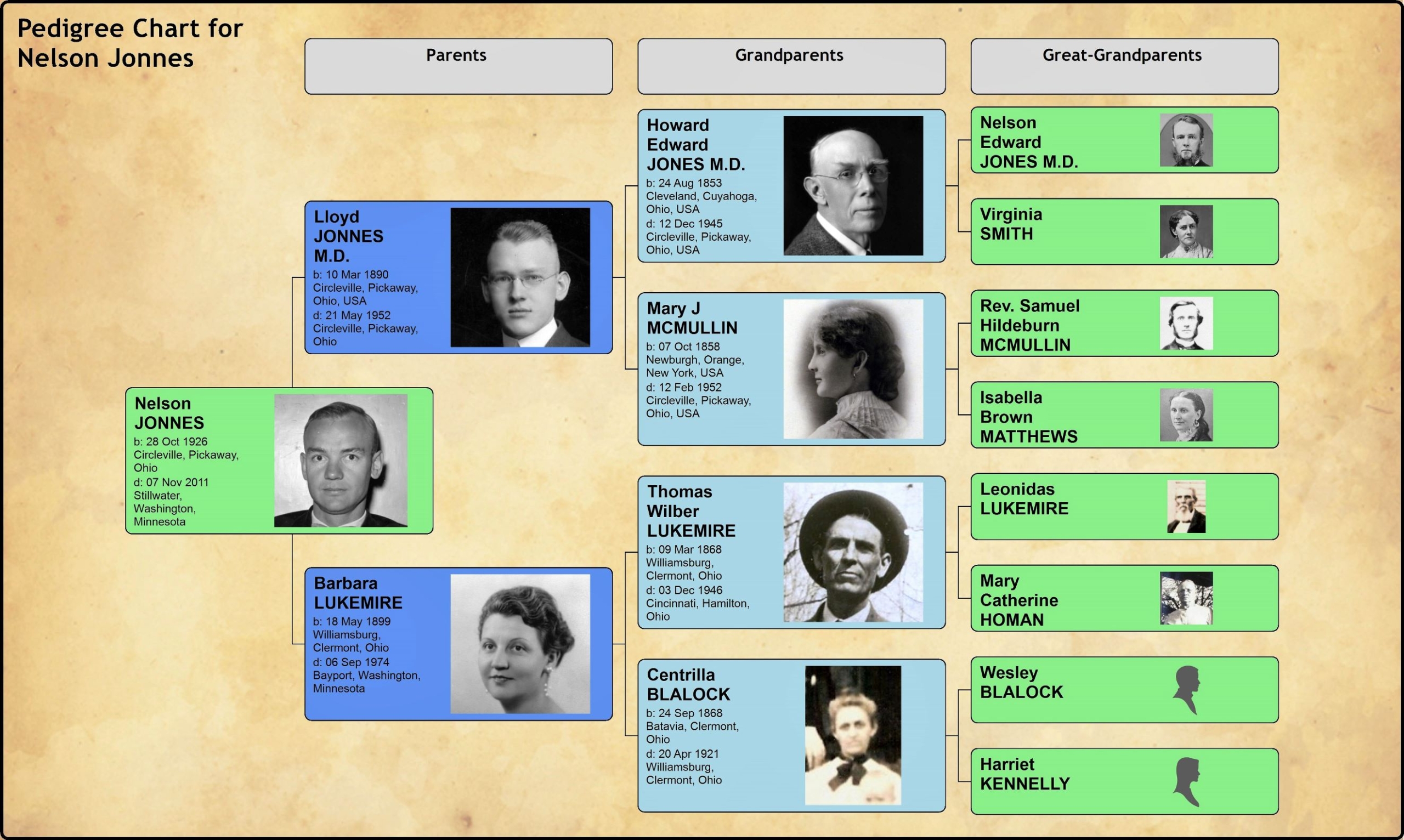
Nelson Jonnes Pedigree Chart (Created November 2021 by author in Family Tree Maker 2019)
Because of gaps and brickwalls, it is likely that additional 18th century immigrant ancestors will be discovered. The McMullins, for example, almost certainly immigrated in the first half of the 18th century. 5GG William McMullin (1729-1797) either immigrated as a child with his parents, who remain unidentified, or was born here after they immigrated. Also, the father of 4GG John Lukemire (1782-1863), was an immigrant from either Germany or Holland, but he also remains unidentified. Several other paternal lines — Wood, Waits, and Kennelly conceivably could reveal immigrant ancestors in the early 18th century. Lastly, the Blalock line remains a huge brickwall. Although the Blalocks themselves probably go back to the 1600s, the maternal branches could reveal more recent immigrant ancestors.
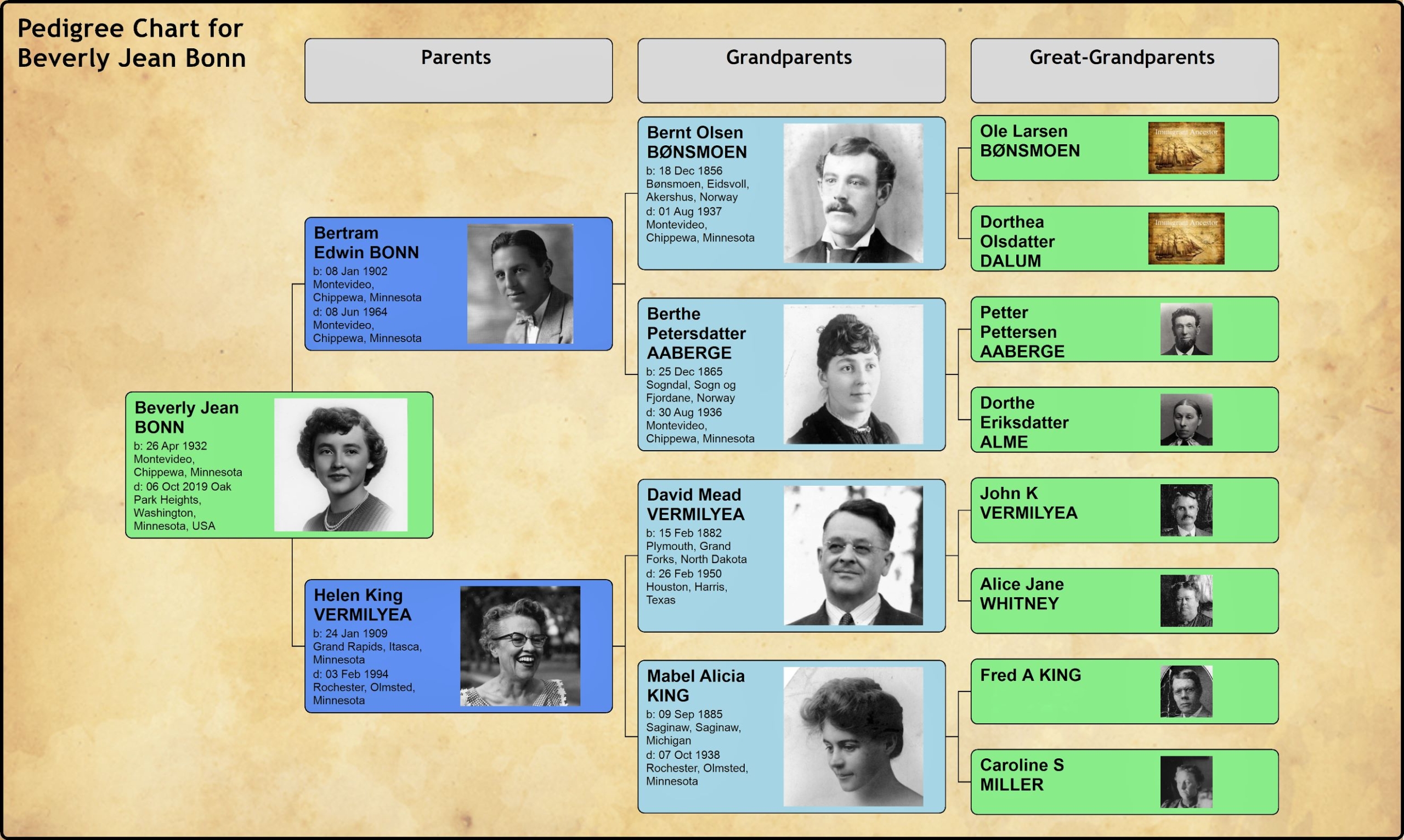
Beverly Jean Bonn Pedigree Chart (Created November 2021 by author in Family Tree Maker 2019)
There’s another distinction between Dad and Mom’s trees that warrants mention. Dad’s earliest immigrant ancestors tend to be 8GG and 9GG while Mom’s tend to be 10GG and 11GG. For example, look at the number of my 8GG immigrant ancestors: 48. Of those, 40 are from Dad’s side and only 8 from Mom’s. But when we look at the 10GGs, we find that 75 of the 91 are from Mom’s side and only 16 from Dad’s.
This imblance is solely a function of the fact that the number of years between generations on Dad’s side are longer than Mom’s. Demographers say the average number of years between generations historically is 27.[7]A 2023 study published in Science Advances found that the average human generation interval over the past 250,000 years was 26.9 years, 30.7 for men and 23.2 for women. Through the first 5 generations, Dad’s generations average 33 years while Mom’s average 30. I think the gap widens even more as you go back in time. Keep in mind that I am not counting the Norwegian side of Mom’s heritage because they immigrated so recently. I only counted the generational years on the maternal half of Mom’s tree (Vermilyea). Almost all of her 10GG and 11GG ancestors are found in the Mead, Whitney, and Price lines.
References
| ↑1 | Nelson Jonnes, “Jonnes Family Record 1995,” 3rd edition, unpublished manuscript; bound copy #6 privately held by Steven Nelson Jonnes, Ashburn, Virginia, 2026. |
|---|---|
| ↑2 | GG stands for great grandfather or great grandmother. |
| ↑3 | I am currently researching whether Ole Larsen Bønsmoen is in fact the biological father of Bernt Olsen Bonn. There is a fair chance he is not. |
| ↑4 | See two posts about her: Berthe Vikheim Immigration and Death Song. |
| ↑5 | Here are a couple: Alsatian Discovery and Crossing the Atlantic in 1827 |
| ↑6 | Read them here: North Yorkshire Ancestors and Maryland House Built by 5GG George Mason |
| ↑7 | A 2023 study published in Science Advances found that the average human generation interval over the past 250,000 years was 26.9 years, 30.7 for men and 23.2 for women. |

