
Avery Vermilya, Whale Hunter and U.S. Marine
Like most Americans in the 19th century, Avery Vermilya (1820-1904) was a farmer. Early in his life, however, Avery went to sea and became a mariner. It’s the most interesting chapter of his life.
Ran Away at Age 16
Avery was raised in Delaware County, New York, in the foothills of the Catskill Mountains. His father Abram Vermilya (1786-1822) died when he was only 18 months old.[1]John Hogan Benton, David Benton, Jr. and Sarah Bingham, Their Ancestors and Descendants (Boston: Press of David Clapp and Son, 1906, p. 73. His mother Charity Molineaux was left to care for eight children, so Avery as the second youngest was packed off to live with his uncle John Vermilya and paternal grandmother Phebe Husted (1755-1839). Uncle John unfortunately was “addicted to the drink habit” and Avery’s early life was “filled with many thorns.”[2]Letter from Mrs. Linda Vermilyea to Beverly Jonnes, date unknown (prob. 1990s), loose-leaf copy privately held by Steven Nelson Jonnes, Ashburn, Virginia, 2025; citing obituary in Mower County … Continue reading
So Avery ran away at age 16 to seek his fortune and commence “life’s journey independent.”[3]Ibid.
Initially, Avery worked as a cook on a steamboat on the Hudson River, which was only 40 miles due east of Roxbury, his hometown. This stage of his life lasted about 2 years.[4]Contrarily, Avery states in a letter less than two years before he died that he went to sea for seven years. I suspect he was confused in old age. Letter from Avery Vermilyea, Dexter, Minnesota … Continue reading (Zoom into the map below and click on the purple icons to learn more; the blue line indicates the Hudson River.)
Becomes a Whaler
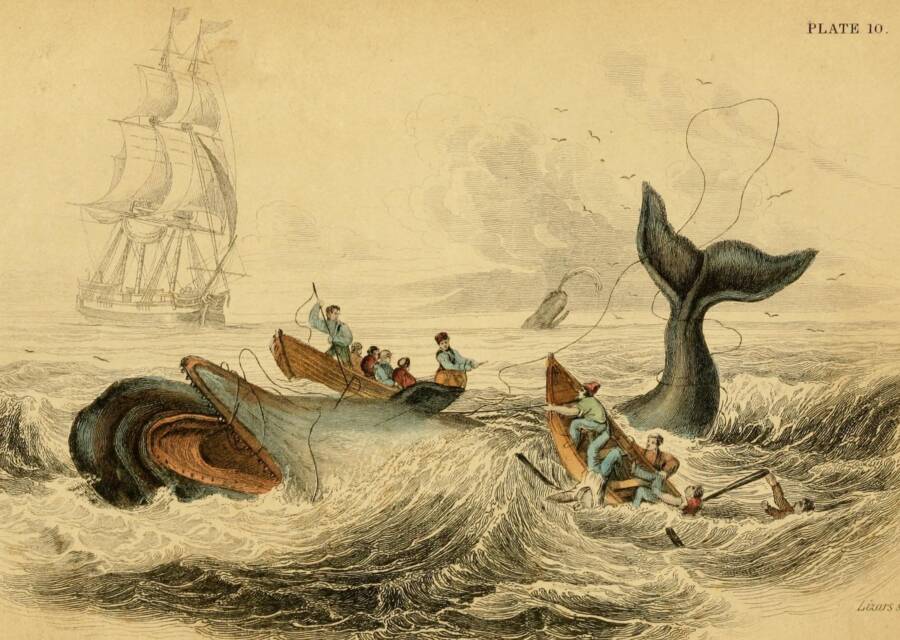
In 1838, Avery went south to New York City and then on to “Boston” where he embarked on a whaling vessel — although I think it likely that Avery actually meant New Bedford rather than Boston. The whaling industry was dominated by the port towns of Nantucket and New Bedford, Massachusetts. (New Bedford was the town featured in Herman Melville’s 1851 classic novel Moby Dick.) Avery remained in the industry for five years.
By the 1820s, the United States was the predominant whaling power in the world. When Avery joined in the late 1830s, most whales were gone from the North Atlantic and whaling ships typically sailed to the South Pacific or Indian Ocean to hunt. Because of the distances, each whaling expedition was typically 2-3 years long.
Since Avery had 5 years of experience, I presume he was on two voyages. He is known to have gone to the Indian Ocean on at least one of those trips. Whalers in the Indian Ocean hunted most often in Antongil Bay off Madagascar, so I think it’s safe to say that Avery is the only one in the family to ever visit Madagascar. He may have also visited the island chains of Mauritius or the Seychelles, which are nearby. (That would be kind of cool since I visited the Seychelles in 1973 on World Campus Afloat.)
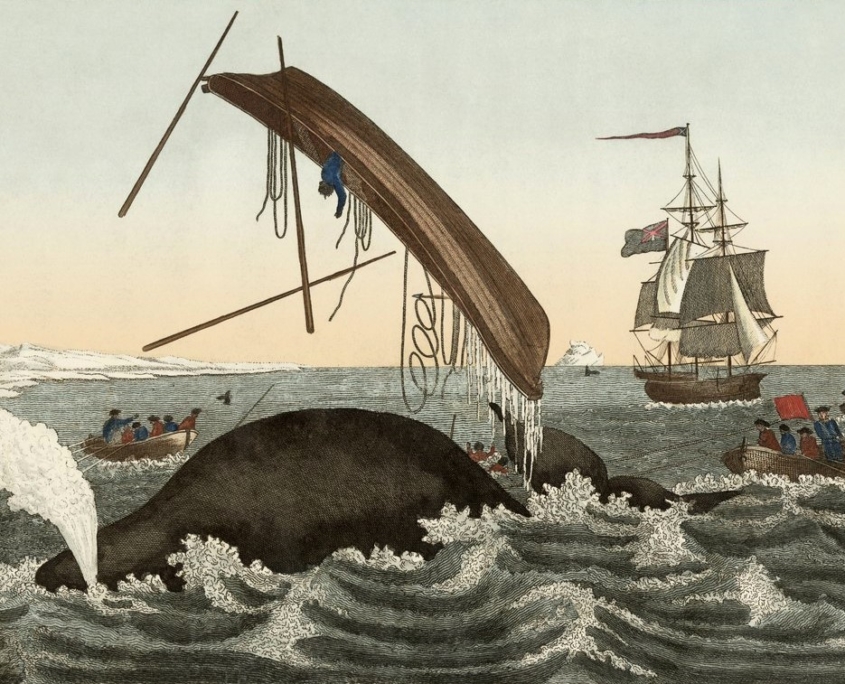
The Dangers of Whale Fishing, anonymous German artist c. 1820s, published by Friedrich Justin Bertuch’s renowned “Picture Book for Children” (1790-1830)
Avery almost lost his life in the Indian Ocean. His children heard this story from him many times:
“He told his children that he was in a boat that harpooned a whale and that, during the event, a whale circled and stove the boat. He was in the Indian Ocean clinging to his oar for ten hours before a ship found and hauled them aboard.”[5]Susan K. Quella & Beverly Bonn Jonnes, “Genealogical Information for Those Who are Descended from Avery Vermilya (1820-1904),” June 2002, unpublished manuscript, p. 6; ring binder copy … Continue reading
USS Missouri
On 7 April 1843, Avery Vermilyea enlisted in the U.S. Marines as a Private at the Brooklyn Marine Barracks in New York City.[6]“U.S., Marine Corps Muster Rolls, 1798-1958,” digital images, Ancestry (https://ancestry.com : 2 June 2025); entry for Avery Vermilya, 7 April 1843 enlistment (Major L. Twiggs, Brooklyn, New … Continue reading At the age of nearly 23 and with five years of experience as a sailor, Avery must have decided he’d had enough of whaling. I’m sure the near-death experience of floating in the Indian Ocean for several hours had its effect.
On 20 May 1843, the Marines transferred Avery to the Marine Detachment aboard the USS Missouri stationed in Washington, D.C.[7]“U.S., Marine Corps Muster Rolls, 1798-1958,” digital images, Ancestry (https://ancestry.com : 2 June 2025); entry for Avery Vermilya, 31 May 1843 muster roll (Lt. Algernon S. Taylor aboard USS … Continue reading
The USS Missouri was a 10-gun side-wheel “steam frigate.”[8]There have been four U.S. naval vessels named after the state of Missouri. Avery’s ship was the first. The 3rd Missouri was the site of Japan’s surrender in World War II. The 4th … Continue reading Pictured below is either the Missouri or its sister ship, the USS Mississippi. Note the sidewheel powered by a steam engine. The vessel was an early sort of hybrid; it used both its sails and sidewheel for propulsion. Both ships were considered the equal of any warships in the world and were the “pride of the country.”[9]Surgeon A. Farenholt, “The Destruction of the U.S. Steam Frigate Missouri at Gibraltar, August 26, 1843,” United States Naval Institute Proceedings 38 (June 1912); online archives, U.S. … Continue reading They were the brainchild of of Commodore Matthew Perry and were constructed under his personal supervision. (The Mississippi became the flagship of Perry’s historic visits to Japan in 1853 and 1854.)
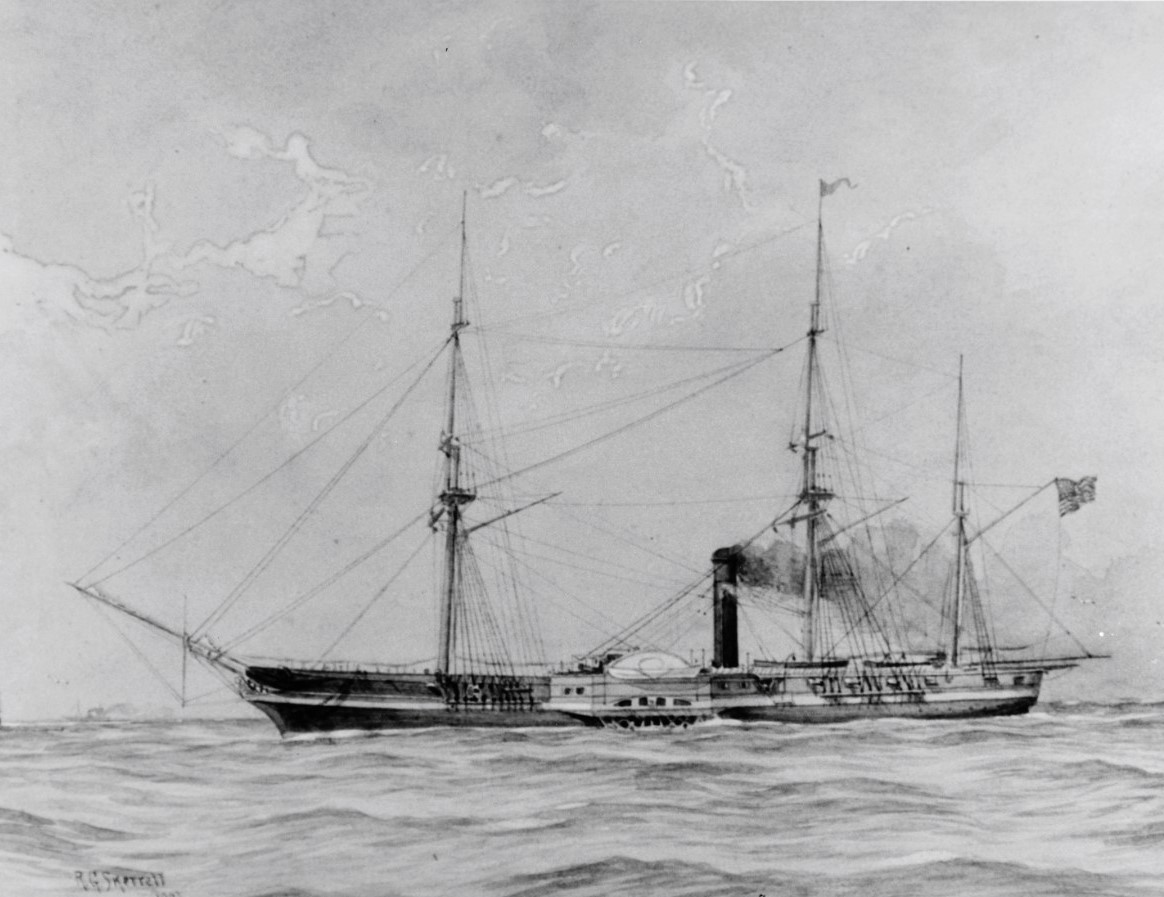
USS Missouri or USS Mississippi, wash drawing by R.G. Skerritt, 1903, depicting one of these identical ships. (Courtesy of R.C. Byron, U.S. Naval History and Heritage Command Photograph.)
Two months later, the USS Missouri was anchored in Norfolk Naval Yards in Portsmouth, Virginia preparing for an important journey to the Mediterranean Sea.[10]“U.S., Marine Corps Muster Rolls, 1798-1958,” digital images, Ancestry (https://ancestry.com : 2 June 2025); entry for Avery Vermilya, 31 July muster roll (Lt. Algernon L. Taylor, USS Missouri, … Continue reading It was transporting Minister Caleb Cushing to Alexandria, Egypt on the first leg of his historic journey to China. President John Tyler had appointed Cushing as the first U.S. ambassador to the Ch’ing Empire, tasked with opening trade.
On 6 August 1843, President Tyler visited the ship and took a several hour tour of Hampton Roads while conferring with Cushing. The President disembarked at Old Point Comfort, and the ship immediately headed out to sea, bound for the Straits of Gibraltar. It was the first power crossing of the Atlantic Ocean by a steam warship.
The Missouri arrived at the Rock of Gibraltar on 25 August 1843 after one stop in the Azores.
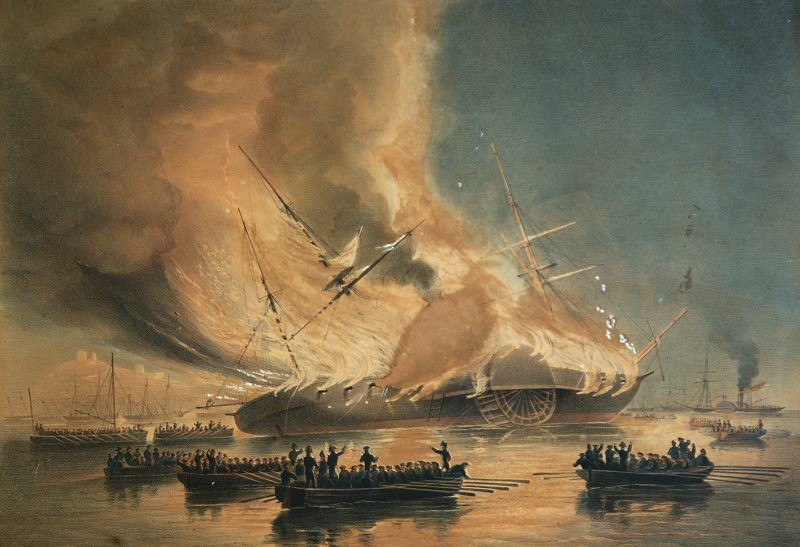
“The accidental burning of the USS Missouri in Gibraltar,” by Edward Duncan, lithograph, 1843 (Public domain).
Disaster struck the very next night, 26 August 1843. Reportedly, a crew member accidentally dropped a demijohn of turpentine in the storeroom which ignited. The officers and crew attempted valiantly to save the ship. Fire lines were formed and engine pumps engaged. Distress signals were set out and nearby vessels came to the rescue. The British opened the gates of Gibralatar, an unprecedented courtesy. A British ship-of-the-line, the HMS Malabar, assisted in fighting the fire, but all was to no avail. With flames engulfing the middle of the deck and the men all bunched at the two ends in increasing fear, the captain finally ordered everyone to abandon ship.[11]Farenholt, “The Destruction of the U.S. Steam Frigate Missouri.”
“Men, save yourselves!”
Because so many ships and boats had surrounded the growing conflagration, everyone got to safety. Amazingly, not a single soul perished.
Around 2:00 in the morning, the fire reached a forward magazine that could not be flooded ahead of time. A massive explosion ripped through the forward hold.
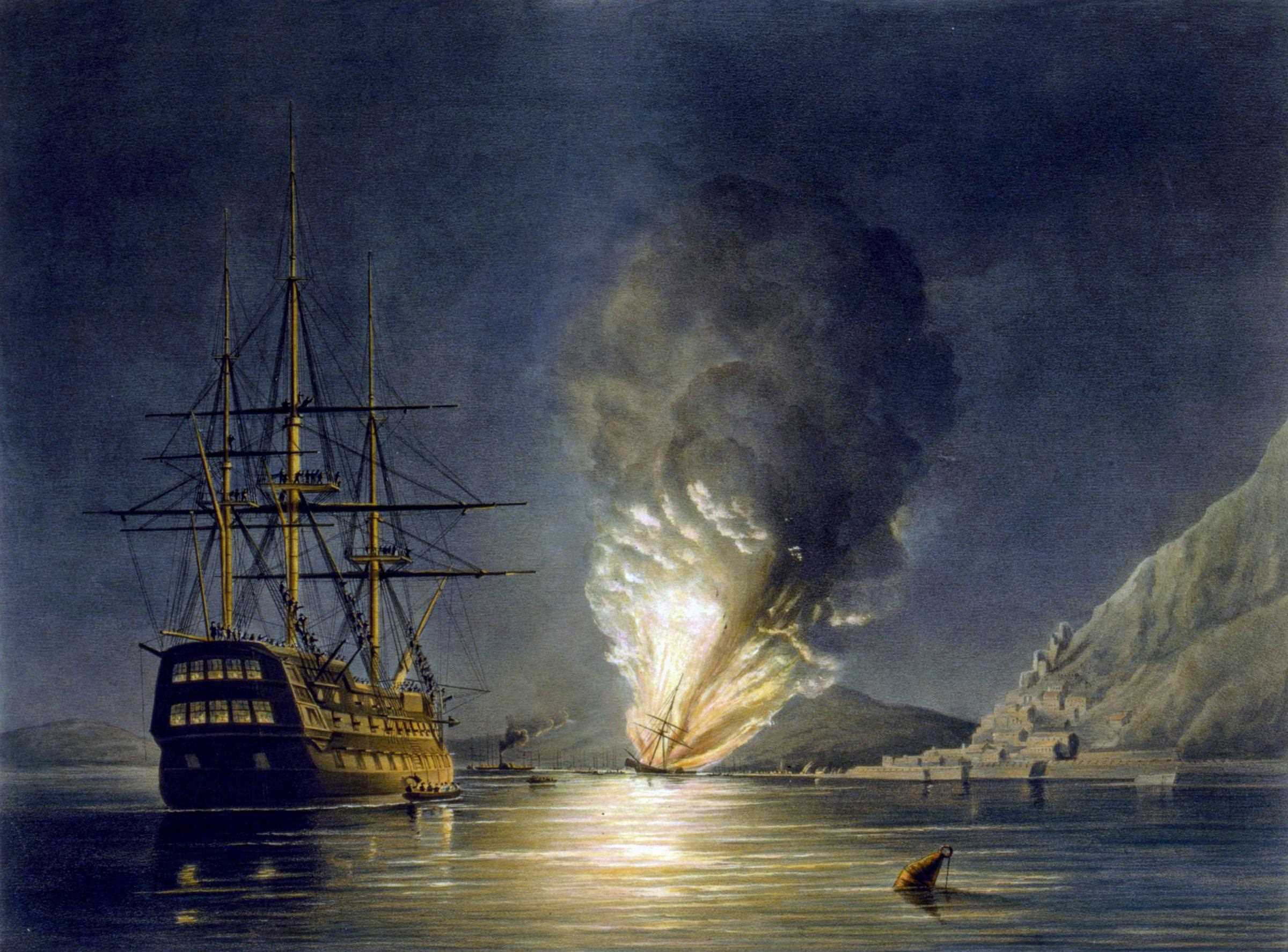
“The Explosion of the United States Steam Frigate Missouri, at Gibralter, Aug. 26th, 1843,” with HMS Malabar in foreground, chromolithogram, bet. 1843 and 1850, drawn by Edward Duncan, lith. T.G. Dutton.
The crew, including the U.S. Marine Detachment, were transferred to the Rajah, a civilian ship which was chartered to take everyone home.
The destruction of the USS Missouri was a huge news story at the time and its captain was court-martialed for negligence.[12]John Newton was convicted and sentenced to suspension from duty, but President Tyler later pardoned him. Cushing, fortunately, was able to save President Tyler’s letter to the Emperor of China and continued his journey. Nearly a year later, on 3 July 1844, Cushing successfully concluded the Treaty of Wangxia.
The Rajah meanwhile took the crew back to America; it arrived in Boston on 16 October 1843. Avery and his fellow marines were transferred that day to the U.S. Marine Barracks in Boston.[13]“U.S., Marine Corps Muster Rolls, 1798-1958,” digital images, Ancestry (https://ancestry.com : 2 June 2025); entry for Avery Vermilya, 31 October muster roll (Lt. Col. Watson, Boston, … Continue reading The return voyage by the way was no picnic. The ship was overcrowded, there were no hammocks and the men were forced to sleep on rugs. The weather was bad as well, so it was a long, miserable 42-day crossing.
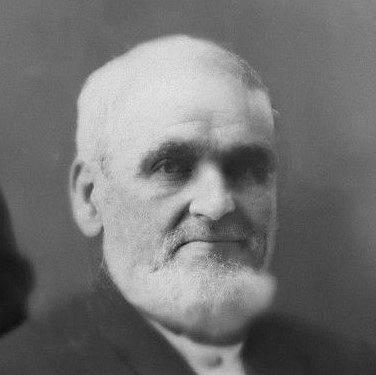
Avery Vermilya circa 1890, enhanced by MyHeritage (Author’s collection)
Deserter
So, here’s a twist. Two weeks after arriving in Boston, Avery Vermilyea deserted from the U.S. Marines!
The following is written opposite Avery Vermilya’s name on the 31 October 1843 Marine Barracks muster roll in Boston:[14]“Marine Corps Muster Rolls,” Avery Vermilyea, 31 October 1843.
“Joined from steamer Missouri 16th. Deserted off liberty 31st inst.”
Avery must have received permission to go on liberty and simply never returned. He is not found in any subsequent U.S. Marine muster roll and no other records regarding his desertion can be located. Avery only served 6 months but should have served 3 years, the normal enlistment period.
I can well imagine that nearly drowning in one ocean and almost perishing in a fire in another viscerally affected Avery’s enthusiasm for life at sea. He probably felt like he had tempted fate too many times and just wanted out regardless of consequences. Desertion after all was a serious offense. Punishment could involve flogging, hard labor, dishonorable discharge, or even being branded with the letter D. During wartime, you might even be executed. (Executions occurred just three years later during the Mexican-American War.) Based on my reading, though, desertion rates were pretty high in the early 19th century — some say as high as 10% — and resources were insufficent to catch everyone. It must have been a calculated gamble on Avery’s part. And maybe the U.S. Marines were less inclined to chase down those who had suffered through the USS Missouri mishap.
I wonder too if Avery never cited his hometown when he enlisted in the U.S. Marines. He had already been absent from Delaware County for 7 years, so he may easily have provided a different address. Without knowing he was from Roxbury, New York, the Marines would have been hard-pressed to find him.
In any case, the gamble paid off. Avery returned immediately to Roxbury. He married Fanny Mead there less than six months later, 20 March 1844.[15]“Minnesota, County Marriages, 1860-1949,” database with images, FamilySearch (https://familysearch.org : 3 November 2019), entry for John R or John K Vermilya and Allie J Whitney, 8 March 1876, … Continue reading Together they had 11 children — nine sons and two daughters — and by my count, 47 grandchildren! Both lived long, fruitful lives. Fanny died at 77 and Avery at 83.
According to his sons, Avery had a full rigged ship tattoo on his chest.[16]Quella & Jonnes, “Descended from Avery Vermilya,” 2002, 6.
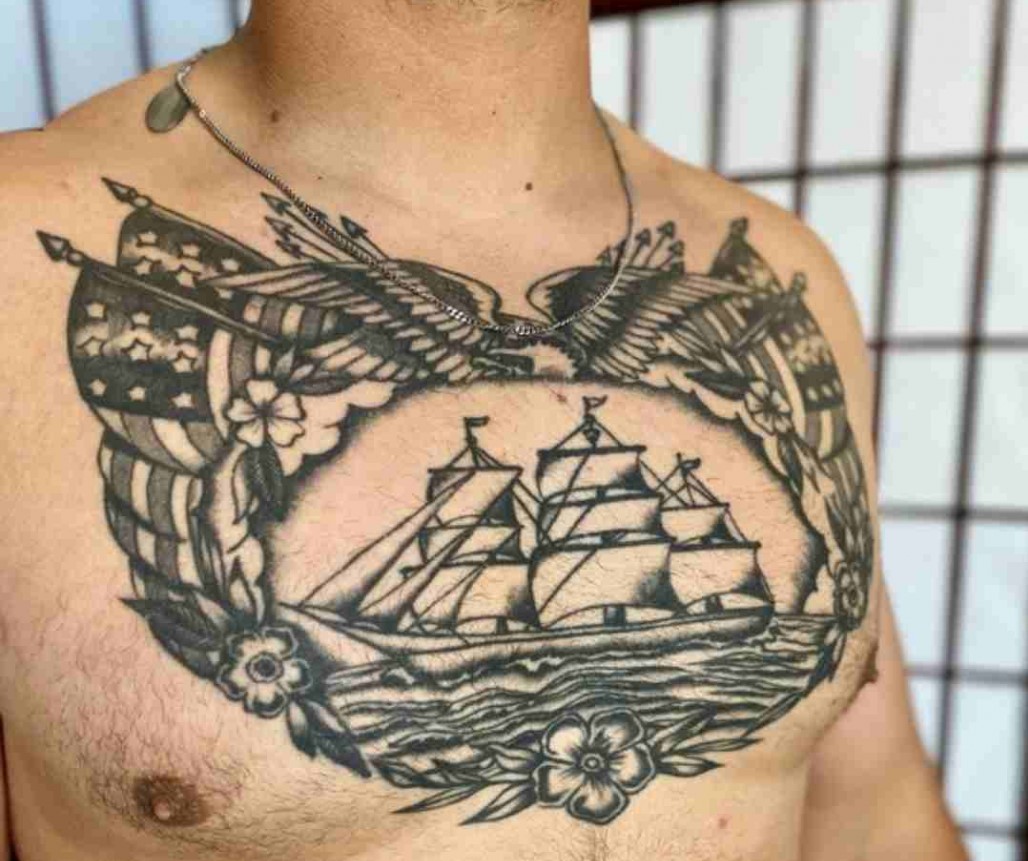
Full chest sailing ship tattoo (Source: ironinktattoosmi.com)
Avery Vermilya Timeline
- 1820 – 1836 = Roxbury, Delaware, New York
- 1836 – 1838 = Hudson River steamboat
- 1838 – 1843 = Whaling
- 1843 – 1843 = U.S. Marines
- 1844 – 1848 = Roxbury, Delaware, New York
- 1848 – 1863 = Owego, Tioga, New York
- 1863 – 1890 = Quincy Township, Olmsted, Minnesota
- 1891 -1904 = Dexter, Mower, Minnesota
References
| ↑1 | John Hogan Benton, David Benton, Jr. and Sarah Bingham, Their Ancestors and Descendants (Boston: Press of David Clapp and Son, 1906, p. 73. |
|---|---|
| ↑2 | Letter from Mrs. Linda Vermilyea to Beverly Jonnes, date unknown (prob. 1990s), loose-leaf copy privately held by Steven Nelson Jonnes, Ashburn, Virginia, 2025; citing obituary in Mower County Transcript, Austin, Minnesota, 15 July 1904, p. 4, col. 4. I have been unable to find the original obituary, however. |
| ↑3 | Ibid. |
| ↑4 | Contrarily, Avery states in a letter less than two years before he died that he went to sea for seven years. I suspect he was confused in old age. Letter from Avery Vermilyea, Dexter, Minnesota to Winifred Randall, Ft Wayne, Indiana, 15 January (or July) 1902, hand-written original privately held by Steven Nelson Jonnes, Asburn, Virginia, 2025. |
| ↑5 | Susan K. Quella & Beverly Bonn Jonnes, “Genealogical Information for Those Who are Descended from Avery Vermilya (1820-1904),” June 2002, unpublished manuscript, p. 6; ring binder copy privately held by Steven Nelson Jonnes, 2025. |
| ↑6 | “U.S., Marine Corps Muster Rolls, 1798-1958,” digital images, Ancestry (https://ancestry.com : 2 June 2025); entry for Avery Vermilya, 7 April 1843 enlistment (Major L. Twiggs, Brooklyn, New York); citing NARA microfilm T1118, Roll 23, p. 113. |
| ↑7 | “U.S., Marine Corps Muster Rolls, 1798-1958,” digital images, Ancestry (https://ancestry.com : 2 June 2025); entry for Avery Vermilya, 31 May 1843 muster roll (Lt. Algernon S. Taylor aboard USS Missouri, Washington, DC); citing NARA microfilm T1118, Roll 23, p. 175. |
| ↑8 | There have been four U.S. naval vessels named after the state of Missouri. Avery’s ship was the first. The 3rd Missouri was the site of Japan’s surrender in World War II. The 4th ship remains in operation today, a Virginia-class submarine commssioned in 2010. |
| ↑9 | Surgeon A. Farenholt, “The Destruction of the U.S. Steam Frigate Missouri at Gibraltar, August 26, 1843,” United States Naval Institute Proceedings 38 (June 1912); online archives, U.S. Naval Institute (www.usni.org/magazines : 9 June 2025. |
| ↑10 | “U.S., Marine Corps Muster Rolls, 1798-1958,” digital images, Ancestry (https://ancestry.com : 2 June 2025); entry for Avery Vermilya, 31 July muster roll (Lt. Algernon L. Taylor, USS Missouri, Norfolk, Virginia); citing NARA microfilm T1118, Roll 23, image 253. |
| ↑11 | Farenholt, “The Destruction of the U.S. Steam Frigate Missouri.” |
| ↑12 | John Newton was convicted and sentenced to suspension from duty, but President Tyler later pardoned him. |
| ↑13 | “U.S., Marine Corps Muster Rolls, 1798-1958,” digital images, Ancestry (https://ancestry.com : 2 June 2025); entry for Avery Vermilya, 31 October muster roll (Lt. Col. Watson, Boston, Massachusetts); citing NARA microfilm T1118, Roll 23, p. 338, line 23. |
| ↑14 | “Marine Corps Muster Rolls,” Avery Vermilyea, 31 October 1843. |
| ↑15 | “Minnesota, County Marriages, 1860-1949,” database with images, FamilySearch (https://familysearch.org : 3 November 2019), entry for John R or John K Vermilya and Allie J Whitney, 8 March 1876, Dover, Olmsted, Minnesota; citing p. 176, image no. 409. |
| ↑16 | Quella & Jonnes, “Descended from Avery Vermilya,” 2002, 6. |

